
Brooklyn and NYC · individuals and couples
Therapy for Asian Americans in Brooklyn and NYC
I am an Asian American therapist in Brooklyn and NYC, offering culturally attuned therapy for first and second-generation adults and couples. I work psychodynamically and relationally with family expectation, identity, intergenerational patterns and achievement pressure. Two Brooklyn offices, plus online sessions across New York State. Free 15-minute consultation.

For a lot of people, the appeal of working with an Asian American therapist is straightforward: less of the session spent explaining the background, more of it spent on what actually brought you here.
No group is a monolith, and therapy is truly as individual as each person. But as the demand for Asian American mental healthcare grows, there are themes and topics that often emerge - topics that I am both particularly attuned to and interested in working with.
Shared context
Why Work With an Asian American Therapist
Most of the people who reach out to me have been in a room before where they had to do the translating. Explaining why a comment from a parent landed the way it did. Explaining that the obligation is real and not a boundary problem. Explaining that leaving would cost something the therapist could not quite see. It is tiring, and it quietly shapes what you bring up and what you leave out.
What shared context changes is not that I will assume I know your story. It is that we can start further in. When you describe a family dynamic, we can spend the session on what it means to you rather than on establishing that it exists. When something is genuinely cultural rather than pathological, I am unlikely to mistake one for the other.
It also changes what can be said about ambivalence. A lot of first and second-generation adults hold real love and real resentment toward the same people at the same time, and are careful about admitting the second half. That ambivalence is usually where the useful work is, and it needs a room where it will not be received as betrayal.
None of this means the work is solely about being Asian American or first-generation. For many of my clients it is background rather than subject.

Your story is individual, but the context is shared.
Areas of focus
Common Topics for AAPI Therapy
While people seek therapy for a host of reasons, and we can always move to what is most pressing or where you need the most support, here are some common reasons Asian Americans often first reach out to get started.
- Conflicts within their family of origin
- Identity and navigating multiple value sets
- Heightened sense of responsibility and obligation
- Perfectionism, over-functioning, and burnout
- Generational trauma
- Relational issues
- Difficulty identifying and communicating emotions
- Impacts of racism on early and current life
Family Expectations and Parental Pressure
Career, partner, geography, timeline. Expectations are often communicated without ever being stated outright, which makes them very hard to negotiate and very easy to absorb as your own. Much of this work is separating what you want from what you were shaped to want, without needing to reject your family to do it.
Identity, Belonging, and Code-Switching
Moving between value systems all day is a skill, and it has a cost. Many clients describe a version of themselves at work, another at home, and an uncertainty about which one is actually them. We work toward something more continuous rather than better performed.
Intergenerational Trauma and Family Patterns
Migration, war, displacement and survival leave patterns that outlive the event and get transmitted through how families handle emotion, silence and safety. Intergenerational trauma therapy is often about making those inherited rules visible enough to choose about. Some of this is also what children of immigrants carry without ever being told it directly.
Achievement, Perfectionism, and Self-Worth
When achievement has been the family's proof that the sacrifice was worth it, rest can feel like a debt. This overlaps heavily with my work on therapy for burnout and career anxiety, and for many clients the two are genuinely the same problem.

The stance
Culturally Sensitive Therapy for First and Second-Gen Adults
Culturally sensitive therapy is less a technique than a stance. It means I do not treat familial obligation as a symptom, or family enmeshment as a diagnosis before we have looked at what closeness means in your family. It means holding open that a decision which reads as self-abandonment from one value system reads as integrity from another, and that you may be in genuine conflict rather than simply confused.
I work with first and second-generation Asian Americans, and also with first-generation immigrants from other backgrounds and people in cross-cultural relationships, where a lot of the same themes appear. If you are not Asian American and this page describes something you recognize, please feel free to reach out, as well.
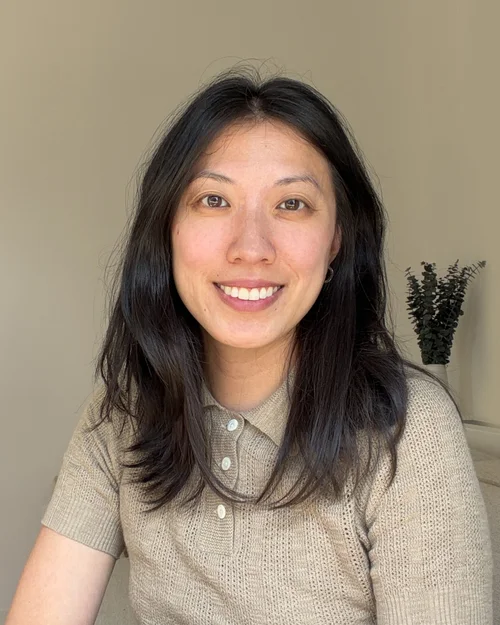
Your therapist
Frances Jin is a Licensed Mental Health Counselor (LMHC) with an MSEd from Hunter College, practicing in Downtown Brooklyn and Greenpoint. About Frances.
The approach
How Culturally Attuned Therapy Works
I practice psychodynamic and relational therapy, informed by EFT training through the NYC EFT externship. That means we pay attention to patterns rather than only to incidents, and to what happens between us in the room as live information about how relationships work for you elsewhere.
In practice, early sessions are mostly about what is pressing now. Over time we look at where the patterns were learned, and what they were protecting.
This is longer-term, trust-based work rather than a fixed number of sessions, and I would rather be straightforward about that than suggest a protocol I do not practice. If you want more on the underlying approach, I have written about relational therapy and about attachment styles.
Sessions are 45 minutes, typically weekly. I see individuals and couples.
Where we meet
Asian American Therapist in Brooklyn and NYC
I see clients in person at two Brooklyn offices and online across New York State.
Downtown Brooklyn
Mondays and Tuesdays
26 Court Street, Brooklyn, NY 11242. Close to Borough Hall, Brooklyn Heights, and many neighborhoods throughout Brooklyn and Manhattan via the 2/3/4/5, A, C, R, F, and G lines.
Greenpoint
Wednesdays
861 Manhattan Avenue, Brooklyn, NY 11222. Convenient for Greenpoint, Williamsburg, and Queens via the G and L lines, and through Court Square.
Online
All Weekdays
Anywhere in New York State.
I am licensed in New York only, and I am out of network, providing superbills for reimbursement.
Questions
Frequently Asked Questions About Asian American Therapy
What makes a therapist culturally attuned?
Mostly, what they do not require you to justify. A culturally attuned therapist holds your background as context rather than as a symptom, does not default to one culture's model of a healthy family, and can sit with the fact that two value systems may both be legitimate and still be in conflict.
Do I have to explain my cultural background in therapy?
Only as much as you want to. Some clients want to work on it directly; for others it is simply the water they swim in and the presenting issue is something else entirely. You set that. What shared context buys you is the option not to start from the beginning.
Do you work with first and second-generation adults?
Yes, and they make up much of my practice. I also work with first-generation immigrants from non-Asian backgrounds, where many of the same themes around obligation, identity and family expectation come up.
Can therapy help with family expectations and parental pressure?
Yes. The goal is usually not to get you to cut anyone off. It is to help you tell the difference between what you want and what you were shaped to want, and to find a way to live closer to the first without losing the relationships that matter to you.
Do you work with Asian American couples?
Yes, I see couples as well as individuals, including cross-cultural couples. Differences in how families handle conflict, closeness and obligation are common and workable material.
Do you offer online therapy across New York State?
Yes, for anyone located in New York State. Online sessions are available on all weekdays; Thursdays and Fridays are online only. I am licensed in New York only.
Where are your offices located?
26 Court Street in Downtown Brooklyn (Mondays and Tuesdays) and 861 Manhattan Avenue in Greenpoint (Wednesdays). Greenpoint currently has limited availability.
What happens in a free 15-minute consultation?
It is a short call to hear what is bringing you here and for you to get a sense of how I work. No preparation needed, and no obligation. If I am not the right fit, I will say so and point you somewhere better.
Next step
Ready to Get Started?
Schedule a free, 15-minute consultation to see what it would be like to work together.
Book a consultation